
Our Curriculum
Learning That Grows With Your Student
Our curriculum is designed to provide a strong academic foundation while allowing students to learn at the level that best matches their abilities and needs.
Rather than teaching every student the same material at the same pace, we focus on helping each learner continue moving forward in their academic journey.
For All Students




-
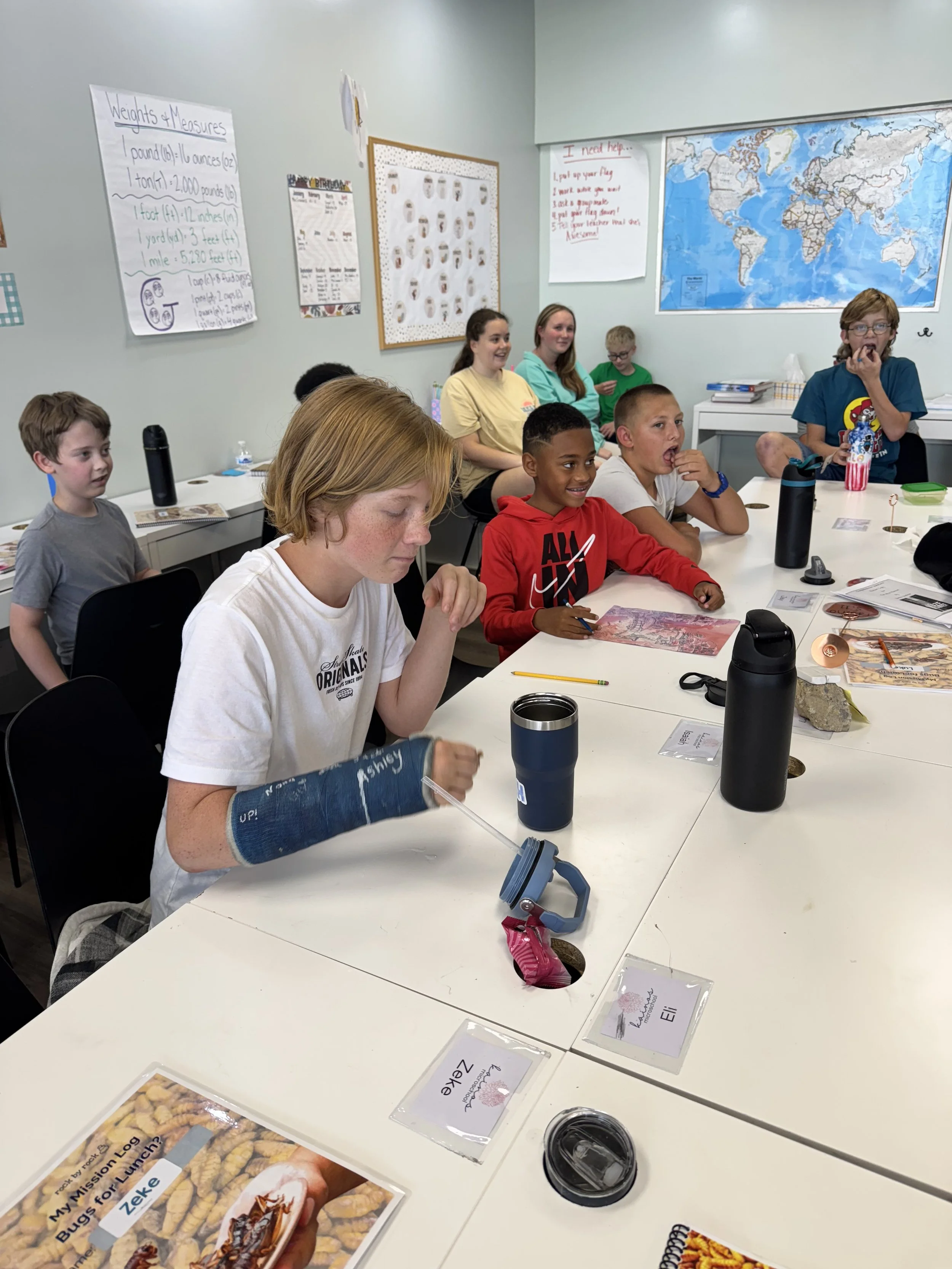
At Kainos, learning extends beyond textbooks and traditional assignments. Through our partnership with Rock by Rock, students participate in meaningful project-based learning experiences that allow them to explore their interests, solve real-world problems, and develop skills that will serve them far beyond the classroom.
Project-based learning challenges students to think critically, collaborate with others, conduct research, and apply what they have learned in authentic ways. Rather than simply learning about a topic, students actively engage with it by creating, designing, building, presenting, and reflecting.
Students may engage with:
Rock by Rock Project-Based Learning curriculum designed to foster creativity, innovation, and real-world problem solving.
Interest-driven projects that encourage students to explore topics they are passionate about.
Research and inquiry experiences that help students ask meaningful questions and seek evidence-based solutions.
Collaborative learning opportunities that develop communication, teamwork, and leadership skills.
Hands-on project creation that transforms ideas into tangible outcomes.
Presentation and reflection opportunities that help students communicate their learning and evaluate their growth.
Real-world applications that connect academic learning to authentic challenges and experiences.
Throughout each project, students move through a structured process that mirrors the way professionals, entrepreneurs, innovators, and leaders solve problems in the real world:
Identify a driving question or challenge
Develop a project plan
Conduct research and inquiry
Design and test solutions
Create a final product or presentation
Share learning with an authentic audience
Reflect, evaluate, and grow
Our goal is to help students become curious, capable learners who can think independently, solve problems creatively, and confidently apply their knowledge in meaningful ways.
-
At Kainos, character development is not a separate subject—it is woven into the fabric of everyday learning. We believe education should help students grow not only academically, but also emotionally, socially, and personally.
Through intentional conversations, mentorship, reflection, and community experiences, students develop the skills needed to navigate life with confidence, compassion, and integrity.
Students may engage with:
Daily reflection and goal-setting practices that encourage self-awareness and personal growth.
One-on-one check-ins with teachers that provide support, accountability, and meaningful connection.
Social-emotional learning experiences that help students identify, understand, and manage emotions in healthy ways.
Conflict resolution and communication skills that strengthen relationships and build empathy.
Character-building discussions focused on responsibility, perseverance, kindness, integrity, and respect.
Leadership opportunities that encourage students to contribute positively to their community.
Mentorship and relationship-building experiences that foster confidence, belonging, and emotional resilience.
Faith-integrated learning opportunities that invite students to explore values, purpose, and personal growth in an environment of respect and curiosity.
As a faith-integrated microschool, we incorporate practices such as prayer, reflection, Scripture reading, and discussions about faith. At the same time, we recognize that students and families come from a variety of backgrounds and experiences. Participation in spiritual practices is never forced, and students are encouraged to engage in ways that are meaningful and comfortable for them.
Our goal is to help students become thoughtful, emotionally healthy individuals who understand themselves, care for others, and contribute positively to the world around them.
-
At Kainos, we recognize that every student learns differently. Students come to us with unique strengths, interests, challenges, goals, and learning styles, which is why we intentionally create learning experiences that meet students where they are and help them grow from there.
Rather than expecting every student to learn the same material at the same pace, we provide opportunities for students to take ownership of their learning while receiving the support and guidance they need to succeed.
Students may engage with:
Individualized learning plans designed around each student's academic needs, goals, and interests.
Self-paced learning opportunities that allow students to progress as they demonstrate understanding and mastery.
Passion projects and independent research that encourage curiosity, creativity, and deeper exploration of topics that matter to them.
Adaptive learning technology that provides personalized instruction, practice, and feedback.
Flexible learning pathways that allow students to build on strengths while receiving support in areas of challenge.
Goal-setting and progress monitoring that help students take ownership of their growth and celebrate achievements.
One-on-one teacher support that provides individualized guidance, encouragement, and accountability.
Choice-driven learning experiences that foster independence, engagement, and intrinsic motivation.
By allowing students to move at an appropriate pace and pursue meaningful learning opportunities, we create an environment where confidence can grow alongside competence.
Our goal is to help students become self-aware, independent learners who understand how they learn best and are equipped to take ownership of their educational journey.
-
At Kainos, learning goes beyond the classroom through Side Quests is our student interest-based learning experience designed to spark curiosity, creativity, and ownership.
Every nine weeks, students choose a topic, skill, passion, or project they want to explore. Whether it's coding a game, learning photography, studying marine biology, building a business idea, mastering an instrument, or pursuing something entirely unique, students take the lead in designing their learning journey.
Throughout the quarter, students:
Set a personalized learning goal
Research, practice, and develop their chosen skill or project
Track their progress and reflect on their learning
Create a final product, project, or demonstration of learning
The journey culminates in our Quarterly Showcase, where students proudly present what they learned, share their process, and demonstrate their final projects with families, peers, and the community.
Side Quests empower students to pursue their interests, develop real-world skills, build confidence, and discover the joy of self-directed learning. Because some of the most meaningful learning happens when students are inspired to follow their curiosity.
Elementary School Students
Typically ages 7-12
-
Our literacy program is designed to help students become skilled readers, critical thinkers, and lifelong learners. Through explicit instruction, engaging literature, and individualized support, students build the foundational skills necessary for academic success and a love of reading.
UFLI Foundations, University of Florida Literacy Institute (UFLI) Foundations, is the foundational reading curriculum we use. UFLI program provides explicit, systematic reading instruction grounded in the science of reading.
UFLI helps students build strong foundational literacy skills through direct instruction in phonemic awareness, phonics, decoding, spelling, and word recognition. With engaging, research-based lessons and targeted practice, students develop the confidence and skills needed to become successful, independent readers.
Students may engage with:
UFLI Foundations to develop phonemic awareness, phonics, decoding, and foundational reading skills.
Lexia Core5 Reading to provide personalized, adaptive instruction that supports each student's individual reading journey.
Read-aloud experiences that expose students to rich vocabulary, diverse perspectives, and high-quality literature.
Independent reading that encourages choice, confidence, and reading stamina.
Picture books, chapter books, poetry, and informational texts that foster curiosity and broaden understanding.
Literature discussions and comprehension activities that help students make connections, ask questions, and think critically about what they read.
Vocabulary development and language enrichment activities that strengthen communication and comprehension skills.
Our goal is not only to teach children how to read, but to help them discover the joy, wonder, and confidence that come from becoming lifelong readers.
-
Our writing and language arts program helps elementary students become confident readers, writers, and communicators.
Instruction is designed to build strong foundational skills while encouraging creativity, critical thinking, and self-expression.
Our students develop strong communication skills through the Institute for Excellence in Writing (IEW) curriculum, a proven approach that makes writing clear, structured, and enjoyable. Through step-by-step instruction, students learn how to organize their thoughts, expand their vocabulary, and write with confidence across a variety of genres.
IEW equips students with essential writing, grammar, and critical thinking skills while fostering creativity and effective self-expression.
Students may engage with:
Institute for Excellence in Writing (IEW) to develop writing structure, organization, vocabulary, and style.
Fix It! Grammar to learn grammar, punctuation, and editing skills within the context of real writing.
Handwriting Without Tears to strengthen handwriting, letter formation, and fine motor skills for younger learners.
Independent writing projects that allow students to practice narrative, informational, and opinion writing.
Vocabulary and language development activities that strengthen communication and comprehension skills.
Manuscript and cursive handwriting practice as students progress through elementary grades.
Through consistent practice and individualized support, students learn to communicate their ideas clearly, organize their thoughts effectively, and develop confidence in their ability to write.
-
Our mathematics program helps students build a strong foundation in number sense, computation, problem-solving, and mathematical reasoning. Math with Confidence is the foundation of our math instruction. Through hands-on learning, engaging activities, and individualized instruction, students develop both confidence and competence in math.
Students may engage with:
Math with Confidence to build a deep understanding of mathematical concepts through engaging lessons and hands-on activities.
Number sense activities that strengthen foundational skills and help students understand how numbers work.
Hands-on manipulatives such as counters, blocks, number lines, and visual models to support conceptual understanding.
Problem-solving experiences that encourage critical thinking, reasoning, and perseverance.
Math games and interactive activities that reinforce skills while making learning enjoyable.
Ascend Math - a prescriptive and adaptive online program that reinforces mastery of foundational math skills.
Times Tales to help students master multiplication facts through memorable stories and visual learning strategies.
Real-world math applications that help students connect mathematical concepts to everyday situations.
Our goal is to help students become confident mathematicians who understand not just how to find an answer, but why it works.
-
Our elementary students explore the wonders of science through the Real Science-4-Kids curriculum, a hands-on, inquiry-based program designed to make complex scientific concepts easy to understand. Through engaging experiments, observations, and interactive activities, students build a strong foundation in biology, chemistry, physics, and earth science. Real Science-4-Kids encourages curiosity, critical thinking, and a love of discovery while helping students see how science connects to the world around them.
Students may engage with:
Real Science 4 Kids to build a strong foundation in scientific thinking by helping students understand how the natural world works.
Science experiments and labs that allow students to test ideas, make observations, and learn through discovery.
Small-group instruction that encourages discussion, collaboration, and deeper understanding.
Educational videos and multimedia resources that bring scientific concepts to life.
Nature studies and outdoor learning experiences that help students observe and interact with the world around them.
STEM activities and problem-solving challenges that encourage creativity, innovation, and critical thinking.
Students explore topics such as life science, earth science, physical science, space, weather, plants, animals, and the human body while developing the skills and curiosity that form the foundation of lifelong scientific learning.
Our goal is to help students become curious thinkers who ask questions, seek understanding, and discover the wonder found throughout God's creation.
-
Our elementary students discover history through The Story of the World, an engaging curriculum that brings the past to life through storytelling. Students journey through ancient civilizations, world cultures, important events, and influential people while developing a deeper understanding of how history has shaped our world. Through read-alouds, discussions, hands-on activities, and projects, students build historical knowledge, critical thinking skills, and a lifelong appreciation for learning about the people and events that came before us.
Students may engage with:
The Story of the World to explore world history through engaging storytelling that brings historical events and civilizations to life.
Historical fiction and literature that help students connect with people and events from the past.
Primary source exploration that encourages students to examine historical documents, artifacts, and firsthand accounts.
Geography studies that help students understand places, cultures, and how people interact with the world around them.
Quarterly hands-on history projects that allow students to create, build, research, and demonstrate their learning in meaningful ways.
Discussions and collaborative activities that encourage students to ask questions, think critically, and make connections between past and present.
Civics and community learning that help students understand citizenship, leadership, and their role in the world around them.
Students explore ancient civilizations, world cultures, American history, geography, and significant historical events while developing an understanding of how the past influences the present.
Our goal is to help students become informed, thoughtful citizens who appreciate history, value diverse perspectives, and understand their place in the larger story of the world.
Middle School Students
Typically ages 12-14
-
Our middle school literacy program helps students become thoughtful readers, effective communicators, and critical thinkers. Through a blend of classic and contemporary literature, students develop reading comprehension, analytical skills, vocabulary, and a deeper understanding of the world around them.
Reading instruction (if needed)- Utilizing UFLI, middle grade students receive explicit reading instruction through the University of Florida Literacy Institute (UFLI) Foundations program to provide explicit, systematic reading instruction grounded in the science of reading. UFLI helps students build strong foundational literacy skills through direct instruction in phonemic awareness, phonics, decoding, spelling, and word recognition. With engaging, research-based lessons and targeted practice, students develop the confidence and skills needed to become successful, independent readers.
Students may engage with:
Classic and modern literature that exposes students to diverse perspectives, cultures, themes, and writing styles.
Novel studies that encourage students to analyze characters, themes, plot development, and author's purpose.
Independent reading that allows students to explore personal interests while building reading stamina and confidence.
Literature discussion groups that promote collaboration, respectful dialogue, and deeper understanding of texts.
Vocabulary development activities that strengthen comprehension and communication skills.
Reading comprehension instruction that helps students make connections, draw conclusions, identify themes, and think critically about what they read.
Literary analysis activities that encourage students to examine text structure, figurative language, point of view, and author's craft.
Cross-curricular reading experiences that incorporate informational texts, primary sources, and nonfiction materials.
Lexia PowerUp provides a personalized, adaptive instruction that supports foundational reading skills in comprehension, spelling, and grammar.
Through meaningful engagement with literature, students learn to ask thoughtful questions, support their ideas with evidence, appreciate diverse viewpoints, and develop a lifelong appreciation for reading.
Our goal is to help students become confident, capable readers who can think critically, communicate effectively, and engage thoughtfully with the world around them.
-
Our writing and language arts program helps students become confident readers, writers, and communicators.
Instruction is designed to build strong foundational skills while encouraging creativity, critical thinking, and self-expression.
Our students develop strong communication skills through the Institute for Excellence in Writing (IEW) curriculum, a proven approach that makes writing clear, structured, and enjoyable. Through step-by-step instruction, students learn how to organize their thoughts, expand their vocabulary, and write with confidence across a variety of genres.
IEW equips students with essential writing, grammar, and critical thinking skills while fostering creativity and effective self-expression.
Students may engage with:
Institute for Excellence in Writing (IEW) to develop strong writing structure, organization, vocabulary, and stylistic techniques.
Fix It! Grammar to strengthen grammar, punctuation, editing, and proofreading skills through the application of language concepts in authentic writing.
Narrative, informational, and persuasive writing assignments that help students communicate effectively across different formats.
Research and report writing projects that build critical thinking, organization, and information literacy skills.
Vocabulary and language development activities that enhance both written and verbal communication.
Peer review and collaborative discussions that help students learn to give and receive constructive feedback.
Creative writing opportunities that encourage imagination, self-expression, and development of an individual writing voice.
Cursive handwriting instruction
As students grow, they learn to write with greater clarity, purpose, and confidence while developing the communication skills needed for future academic success and everyday life.
Our goal is to help students become thoughtful writers who can effectively organize ideas, support their thinking, and communicate with confidence in a variety of settings.
-
Utilizing Math with Confidence and transitioning to Denison Algebra, students continue to strengthen mathematical reasoning, problem-solving abilities, and conceptual understanding and move into building a strong foundation in pre-algebra and algebraic thinking through engaging, student-friendly instruction.
Students may engage with:
Math with Confidence to strengthen mathematical reasoning, problem-solving abilities, and conceptual understanding.
Denison Mathematics to build a strong foundation in pre-algebra and algebraic thinking through engaging, student-friendly instruction.
Pre-Algebra concepts including integers, fractions, ratios, proportions, equations, and introductory algebraic reasoning.
Problem-solving activities that encourage critical thinking, logical reasoning, and perseverance.
Real-world math applications that help students understand how mathematics is used in everyday life.
Ascend Math for personalized practice, skill reinforcement, and targeted support when additional instruction is needed.
Math discussions and collaborative learning opportunities that encourage students to explain their thinking and learn from others.
Independent and guided practice that helps students build accuracy, fluency, and confidence.
As students progress through middle school, they develop the skills necessary to tackle increasingly complex mathematical concepts while gaining confidence in their ability to solve problems and think analytically.
Our goal is to help students become capable, confident mathematicians who understand mathematical concepts, apply them effectively, and approach challenges with persistence and curiosity.
-
Our middle school science program encourages students to investigate, analyze, and better understand the world around them. Through hands-on experiments, scientific inquiry, and engaging coursework, students develop critical thinking skills while building a strong foundation in life, physical, and earth sciences.
Real Science-4-Kids, our core curriculum, encourages curiosity, critical thinking, and a love of discovery while helping students see how science connects to the world around them.
For students needing something more rigorous, we can incorporate MasterBooks Science as well.
Students may engage with:
MasterBooks Science to explore scientific concepts through engaging lessons, labs, and real-world applications.
Real Science 4 Kids to build a deeper understanding of scientific principles and the interconnected nature of biology, chemistry, physics, and earth science.
Laboratory experiments and hands-on investigations that allow students to test hypotheses, collect data, and draw conclusions.
Small-group instruction and discussions that promote collaboration, scientific reasoning, and deeper understanding.
Scientific texts, videos, and multimedia resources that bring complex concepts to life.
STEM challenges and problem-solving activities that encourage innovation, creativity, and analytical thinking.
Scientific observation and research projects that help students apply the scientific method and communicate their findings.
Students explore topics such as biology, chemistry, physics, earth science, space science, ecosystems, weather, and the human body while developing the skills necessary to think critically and investigate the world around them.
Our goal is to help students become curious, capable learners who ask thoughtful questions, seek evidence-based answers, and develop an appreciation for the complexity and wonder of the natural world.
-
Our middle school history and social studies program helps students understand the events, cultures, ideas, and people that have shaped our world. Through historical inquiry, primary sources, literature, and hands-on projects, students learn to think critically about the past while making meaningful connections to the present.
Story of the World is the core curriculum, but for students who need more we can place them in Notgrass History.
Students may engage with:
The Story of the World to explore world history through engaging narratives that bring historical events and civilizations to life.
Notgrass History to deepen understanding through rich lessons, primary source documents, maps, literature, photographs, and historical analysis.
Primary source exploration that encourages students to examine historical documents, speeches, letters, and artifacts from the people who lived through history.
Historical literature and biographies that help students better understand different cultures, perspectives, and time periods.
Geography studies that build understanding of world regions, cultures, physical geography, and global connections.
Quarterly hands-on history projects that allow students to research, create, present, and demonstrate their learning in meaningful ways.
Discussions and historical analysis activities that encourage students to ask questions, evaluate evidence, and consider multiple perspectives.
Civics and government studies that help students understand citizenship, leadership, civic responsibility, and the role of government in society.
Students explore ancient civilizations, world history, American history, geography, government, and cultural studies while developing research, critical thinking, and communication skills.
Our goal is to help students become informed, thoughtful citizens who understand how the past shapes the present and are prepared to engage responsibly in their communities and the wider world.
High School Students
Typically ages 14-18
-
Our high school literacy program challenges students to become thoughtful readers, effective communicators, and analytical thinkers. Through a blend of classic and contemporary literature, students explore complex ideas, diverse perspectives, and enduring themes while developing the skills necessary for college, career, and lifelong learning.
Students may engage with:
Classic and modern literature that exposes students to a wide range of voices, cultures, historical contexts, and literary traditions.
Novel studies that encourage deeper analysis of themes, character development, symbolism, literary devices, and author's purpose.
Independent reading that allows students to pursue personal interests while strengthening reading comprehension and critical thinking skills.
Literature discussion groups and seminars that promote thoughtful dialogue, collaboration, and respectful engagement with differing viewpoints.
Literary analysis activities that help students evaluate texts, identify patterns and themes, and support interpretations with evidence.
Vocabulary and language development that strengthens comprehension, communication, and academic readiness.
Nonfiction and informational text studies that build research, analysis, and media literacy skills.
Cross-curricular reading experiences that connect literature to history, current events, culture, and real-world issues.
As students progress through high school, they learn to read with greater depth, analyze complex ideas, evaluate evidence, and communicate thoughtful insights about what they read.
Our goal is to help students become confident, independent readers who can think critically, engage thoughtfully with diverse perspectives, and navigate an increasingly complex world with understanding and discernment.
-
Our writing and language arts program helps students become confident readers, writers, and communicators.
Instruction is designed to build strong foundational skills while encouraging creativity, critical thinking, and self-expression.
Our students develop strong communication skills through the Institute for Excellence in Writing (IEW) curriculum, a proven approach that makes writing clear, structured, and enjoyable. Through step-by-step instruction, students learn how to organize their thoughts, expand their vocabulary, and write with confidence across a variety of genres.
IEW equips students with essential writing, grammar, and critical thinking skills while fostering creativity and effective self-expression.
Students may engage with:
Institute for Excellence in Writing (IEW) to strengthen writing structure, organization, style, vocabulary, and analytical thinking.
Fix It! Grammar to reinforce grammar, punctuation, editing, and proofreading skills within the context of meaningful writing.
Analytical and literary writing assignments that encourage students to evaluate texts, support arguments, and communicate complex ideas.
Research papers and academic writing projects that develop critical thinking, source evaluation, and information literacy skills.
Persuasive, argumentative, and expository writing that prepares students to communicate effectively in academic and real-world settings.
Creative writing opportunities that encourage self-expression, storytelling, and development of an individual writing voice.
Vocabulary and language development activities that strengthen communication and prepare students for higher-level academic work.
Cursive handwriting instruction & practice
As students progress through high school, they learn to write with greater clarity, precision, and purpose while developing the confidence to communicate effectively across a variety of formats and audiences.
Our goal is to help students become skilled writers, thoughtful communicators, and critical thinkers who are prepared to succeed in college, careers, and beyond.
-
Our high school students build a strong foundation in mathematics through Denison Algebra, a mastery-based curriculum designed to make algebra both understandable and engaging. With clear instruction, guided practice, and real-world applications, students develop problem-solving skills, mathematical reasoning, and confidence in their abilities. Denison Algebra emphasizes deep understanding rather than memorization, helping students gain the skills they need for success in higher-level mathematics and everyday life.
Students may engage with:
Denison Mathematics courses ranging from Pre-Algebra through Pre-Calculus and Trigonometry, providing clear, accessible instruction and a strong focus on conceptual understanding.
Algebra and advanced mathematics coursework that develops logical reasoning, problem-solving, and mathematical communication skills.
Independent and guided practice that allows students to strengthen skills, deepen understanding, and build confidence.
Real-world applications of mathematics that help students connect mathematical concepts to everyday life and future career pathways.
Problem-solving activities that encourage critical thinking, perseverance, and analytical reasoning.
Technology-enhanced learning tools that support instruction, practice, and mastery of mathematical concepts.
Individualized pacing and support that allows students to progress according to their readiness and academic goals.
Dual enrollment opportunities for students who wish to pursue college-level mathematics while still in high school.
Ascend Math for personalized practice, skill reinforcement, and targeted support when additional instruction is needed.
As students advance through high school, they develop the mathematical knowledge and confidence needed to tackle increasingly complex concepts and prepare for post-secondary education, technical training, or the workforce.
Our goal is to help students become capable, confident problem-solvers who can apply mathematical thinking to academic challenges, career opportunities, and everyday life.
-
Our high school science program challenges students to think critically, investigate complex questions, and develop a deeper understanding of the natural world. Through rigorous coursework, hands-on labs, scientific inquiry, and real-world applications, students build the knowledge and skills necessary for future academic and career pursuits.
Students may engage with:
MasterBooks Science to explore scientific concepts through comprehensive instruction, critical thinking activities, and laboratory experiences.
The Good and The Beautiful Science to encourage exploration, observation, and scientific inquiry through engaging lessons and investigations.
Laboratory experiments and hands-on investigations that allow students to apply scientific concepts, collect data, and analyze results.
Scientific texts, videos, and multimedia resources that deepen understanding and bring complex topics to life.
Research projects and scientific presentations that strengthen analytical thinking, communication, and problem-solving skills.
Small-group discussions and collaborative learning opportunities that encourage inquiry, exploration, and evidence-based reasoning.
STEM-focused activities and real-world applications that connect scientific concepts to future careers, current technologies, and everyday life.
Students explore topics such as biology, chemistry, physics, environmental science, earth science, human anatomy, and scientific research while developing the skills needed to evaluate information, solve problems, and think scientifically.
Our goal is to help students become informed, curious, and capable thinkers who can apply scientific knowledge, evaluate evidence, and engage thoughtfully with the world around them.
-
Our high school history and social studies program challenges students to think critically about the events, ideas, cultures, and people that have shaped our world. Through historical analysis, primary source research, literature, discussion, and project-based learning, students develop a deeper understanding of the past and its impact on the present.
Students may engage with:
Notgrass History to explore world history, American history, government, economics, and cultural studies through engaging lessons, literature, and primary source materials.
Primary source analysis that encourages students to evaluate historical documents, speeches, letters, maps, and firsthand accounts.
Historical literature and biographies that help students understand diverse perspectives and experiences throughout history.
Research projects and presentations that strengthen critical thinking, communication, and information literacy skills.
Quarterly hands-on history projects that allow students to demonstrate learning through creative, analytical, and collaborative experiences.
Discussions, debates, and historical inquiry activities that encourage students to examine multiple viewpoints and support conclusions with evidence.
Government, civics, and economics studies that prepare students to understand their responsibilities as informed and engaged citizens.
Students explore ancient civilizations, world history, United States history, geography, government, economics, and contemporary issues while developing the skills needed to analyze information, evaluate perspectives, and make informed decisions.
Our goal is to help students become knowledgeable, thoughtful citizens who understand the complexities of history, appreciate diverse viewpoints, and are prepared to engage responsibly in their communities, their nation, and the world.
-
At Kainos, we believe education should help students discover their interests, explore future possibilities, and develop skills beyond the core academic subjects. Our high school elective offerings provide students with opportunities to personalize their educational experience while working toward graduation requirements and future goals.
Students may engage with:
Arizona State University Digital Prep courses that offer a wide range of high-quality elective and graduation requirement options.
Career exploration courses that help students discover potential career paths, interests, and strengths.
Foreign language courses that build communication skills and cultural awareness.
Physical education and wellness courses that promote healthy habits and lifelong fitness.
Technology and digital learning opportunities that prepare students for an increasingly connected world.
Interest-based electives that allow students to pursue areas of passion and curiosity.
Arts and creative expression opportunities including visual arts, music, and other creative pursuits.
Experiential learning opportunities that connect classroom learning to real-world interests and future goals.
Customized credit opportunities that recognize meaningful learning through extracurricular involvement, independent study, volunteer experiences, and other approved activities.
Because every student's path is unique, we work closely with families to help students select courses and experiences that align with their interests, strengths, graduation requirements, and post-secondary goals.
Our goal is to help students develop a well-rounded education while discovering their passions, building practical skills, and preparing confidently for life after high school.